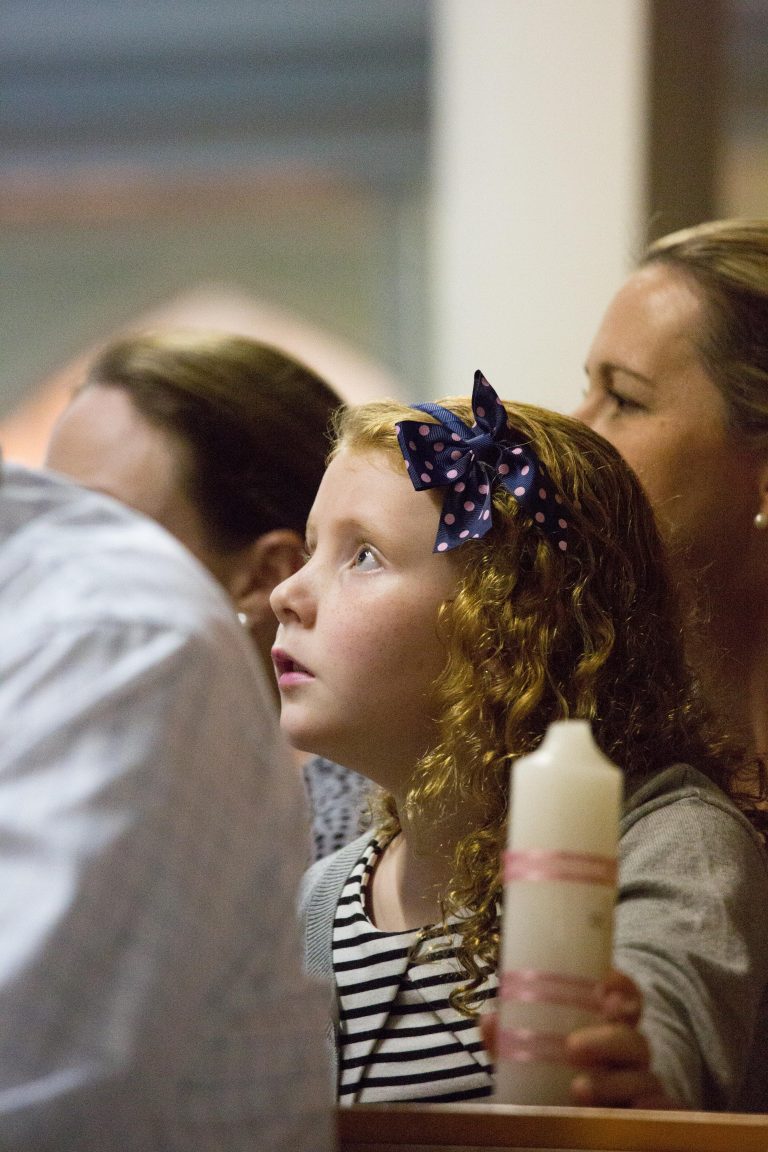
Receive the Light of Christ
Welcome to Flame of Faith!
Perhaps you’ve stumbled across this page and decided to take a look. Maybe you’re a parent seeking information about having your child baptised, or about preparing with your child for Confirmation or Eucharist. Perhaps you’re part of a parish or community team looking for resources to share with families. Whoever you are, we invite you to explore and discover what’s here.
As you scroll through, we encourage you to keep something important in mind: the sacraments are “visible signs of an invisible reality” (St Augustine). This means that through words and gestures, signs and symbols, we encounter Christ Jesus just as the people of the Gospels did so many years ago. Through the sacraments, God blesses us, sustains us, heals us, forgives us, and empowers us to live the Christian life.
As you engage with these pages, we pray that you encounter Christ Jesus in a new and wonderful way, so that your own flame of faith will burn ever brighter.
What is Baptism?
Baptism is the first of three Sacraments of Initiation in the Catholic Church, alongside Confirmation and Eucharist. It’s a joyful moment that marks the beginning of a person’s journey of faith—a step into a life filled with grace, guided by the Holy Spirit.
Through Baptism, we are welcomed into God’s family. It is a moment of profound transformation, where we are washed clean of sin and begin a new life as children of God. We become one with Christ Jesus, join the Church community, and are invited to share in its mission of love and service.
The word ‘baptism’ comes from the Greek baptizein, meaning “to plunge” or “to immerse.” True to its name, Baptism is celebrated by immersing in or pouring water, accompanied by the words:
“I baptise you in the name of the Father, and of the Son, and of the Holy Spirit.”
When parents bring their child forward for Baptism, they say ‘yes’ to a sacred responsibility: to nurture their child in the Catholic faith, to teach them to live by God’s commandments, and to help keep the flame of faith burning brightly in their heart.
But they are never alone in this mission! Godparents, together with the whole faith community, stand alongside them—ready to support, encourage, and inspire as they make the life of faith a daily reality in their family.
What happens during a Baptism?
Reception of the Child
The Baptism ceremony begins at the entrance of the church where the parents and godparents are waiting with those who are to be baptised.
The priest or deacon will ask the parents what name they have given their child and what they ask of God’s church – baptism. They are also asked if they accept the responsibility of bringing up their child in the practice of the Christian faith.
The priest or deacon, with the parents and the godparents, greet the child and trace the Sign of the Cross on their forehead.
Celebration of the Sacrament
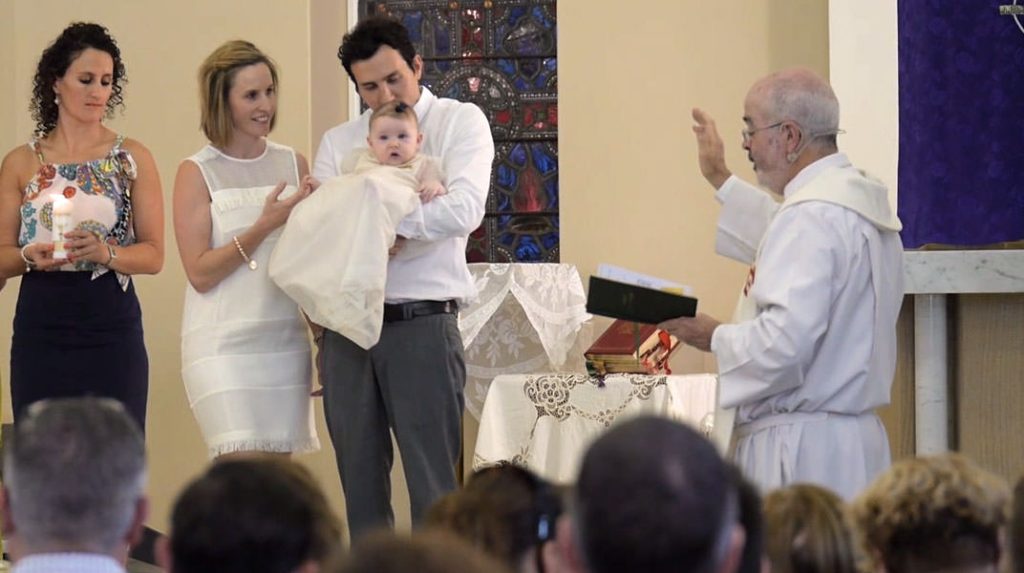
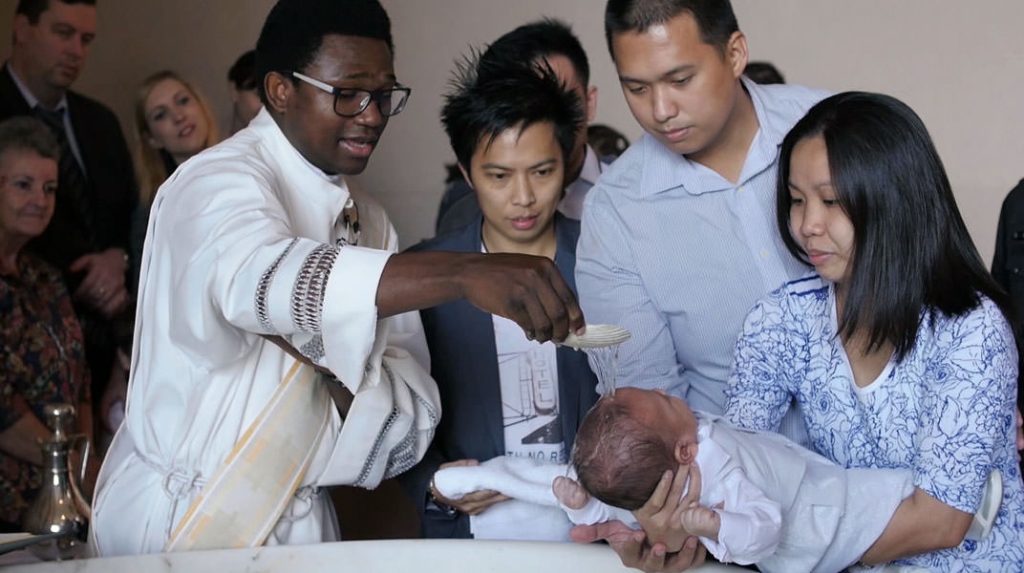
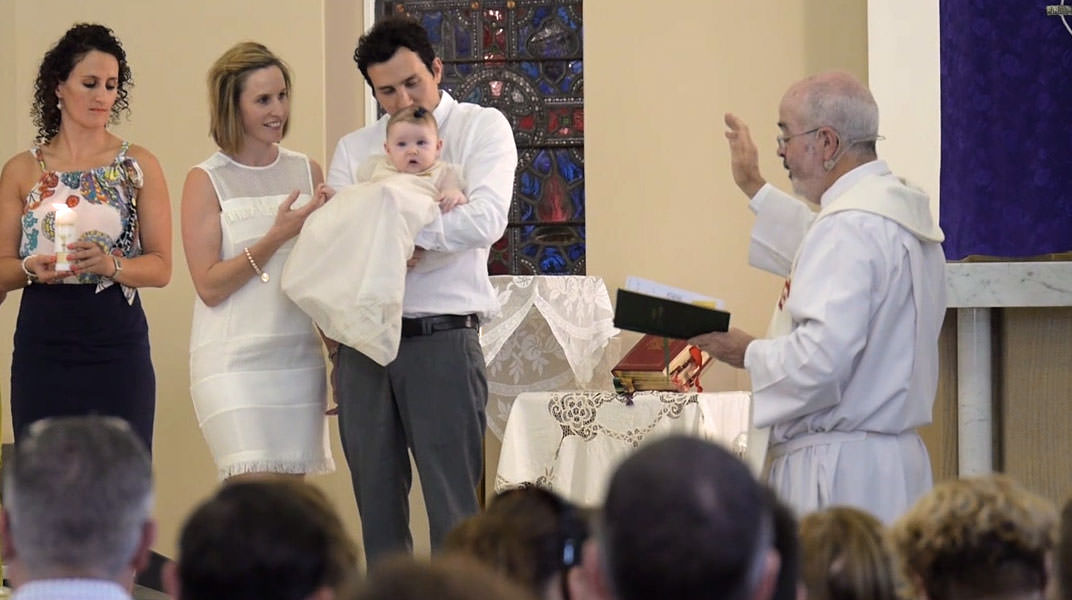
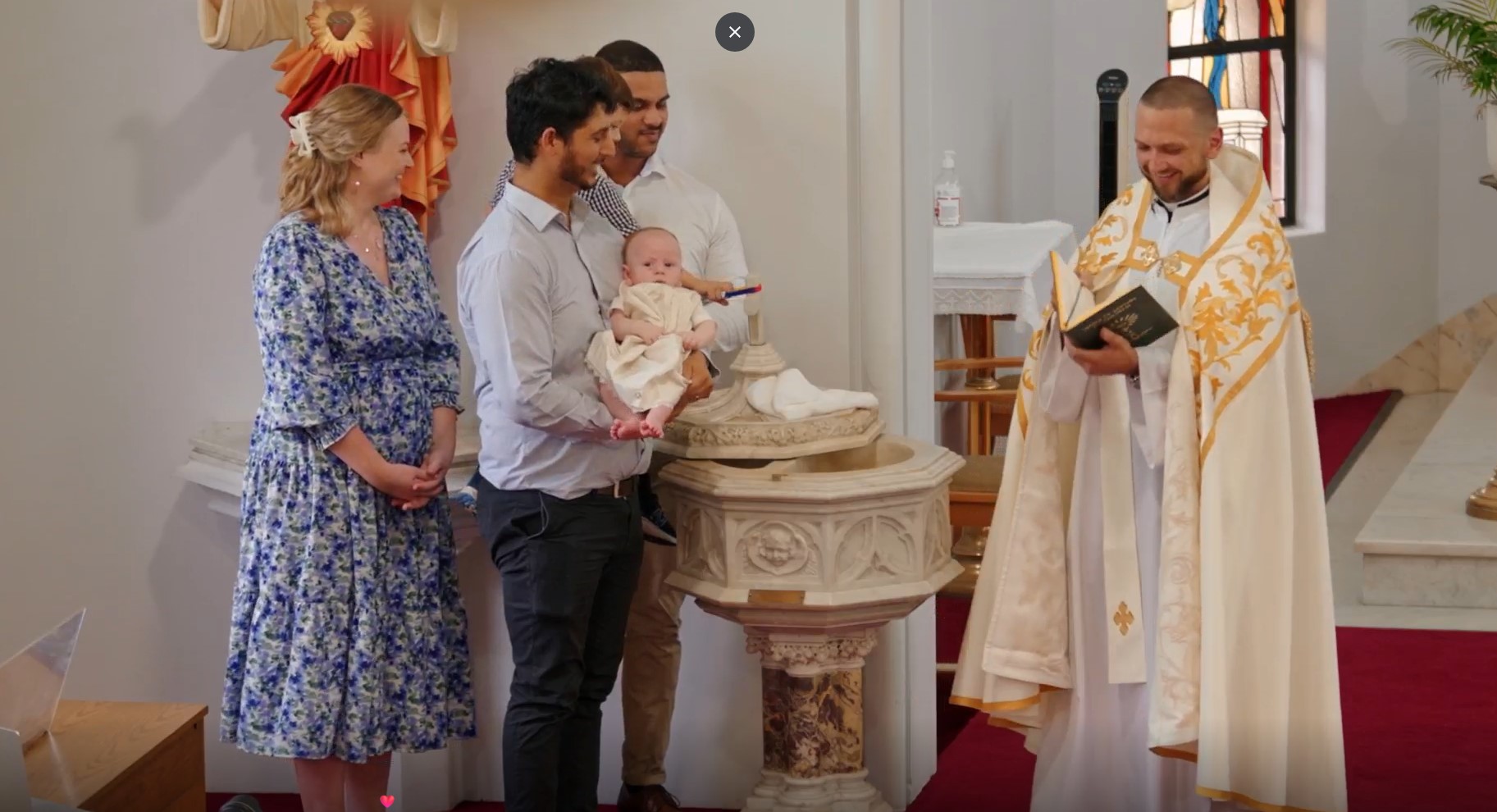
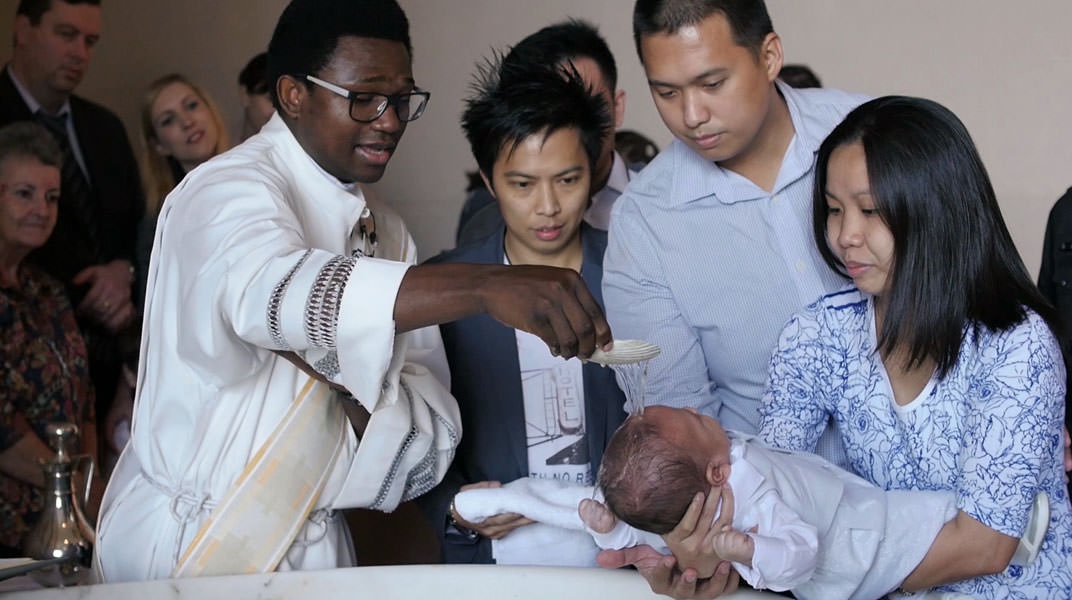
Parents and godparents then renew the promises which were made at their own Baptism before the priest or deacon pours the baptismal water over your child’s head or immerses them three times saying
“I baptise you in the name of the Father,
and of the Son,
and of the Holy Spirit.”
Further signs and symbols continue to demonstrate what we celebrate in Baptism.
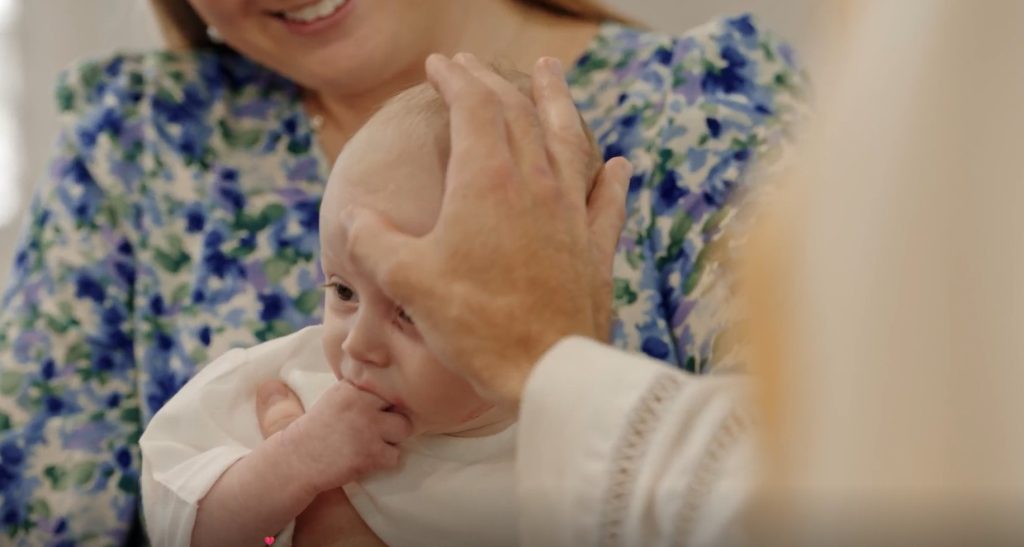
The child is anointed with the Oil of Chrism – a perfumed oil that was consecrated by the bishop, signifying the gift of the Holy Spirit to the newly baptised.
They are clothed in a white garment which symbolises that the person baptised has ‘put on’ Christ.
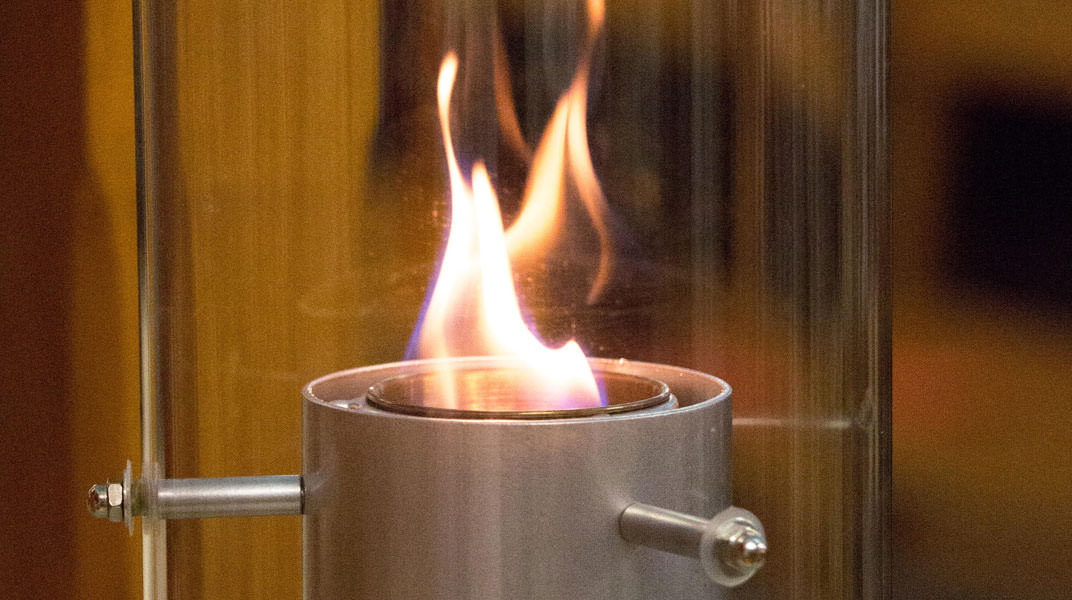
They receive a baptismal candle, lit from the Easter candle, which signifies that the newly baptised has been enlightened by Christ Jesus.
The priest or deacon will then bless the child’s ears so that they will listen to the teachings of Christ and the lips to proclaim the Good News.
Liturgy of the Word
The Liturgy of the Word is the part of the ceremony where scripture is proclaimed. Just as the Holy Spirit inspired the authors of these sacred texts, it is the same Spirit who breathes life into these words, making them meaningful and transformative for believers today.
Prayers are offered for the child and their family in the Prayer of the Faithful, and the community present asks for the intercession of the saints in Heaven in the Litany of Saints, reminding us that Baptism is a gathering of the whole family of the Church, including those who’ve gone before us.
The child is anointed on the chest with the Oil of Catechumens which signifies the strengthening and healing that Christ brings through Baptism.
Conclusion of the Rite
The celebration concludes as everyone prays together the prayer Christ taught us, the Our Father. The priest or deacon will pray a blessing for the parents and all who have joined in this joyful welcoming of a new Christian into the Church.
Symbols used in Baptism

Water
Water is the central symbol of Baptism. The baptismal water is consecrated by a prayer of epiclesis. The priest or deacon touches the water and holds his hand over it. He asks God that, through his Son, the power of the Holy Spirit may be sent upon the water, so that those who will be baptised in it may be ‘born of water and the Spirit’” (CCC, 1238).
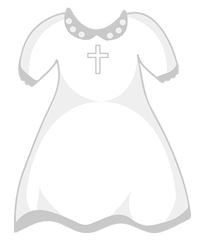
White Garment
The white garment symbolises that the person baptised has ‘put on Christ’ (CCC, 1243)
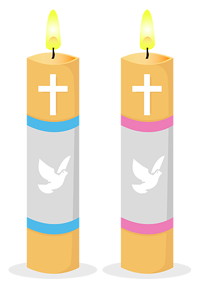
Candle/Light
A baptismal candle is lit from the paschal candle (sometimes called the Easter candle) and presented to the new member as a sign of the light of Christ that has enlightened their life.

Oil of Catechumens & Oil of Chrism
Oil is used twice in the ceremony. Before the Baptism, the child’s breast is anointed with the Oil of Catechumens as a sign of healing and strengthening (CCC, 1237). After Baptism, the crown of the head is smeared with the Oil of Chrism. This perfumed oil, consecrated by the bishop, signifies the gift of the Holy Spirit to the newly baptised, who has become a Christian, that is, one "anointed" by the Holy Spirit, incorporated into Christ (CCC,1241)

The Assembly
The assembled community at Baptism is a symbol of welcome and represents the community of Christ into which the baptised will be incorporated.

The Word of God
The scriptures are always proclaimed at a baptismal liturgy. Jesus is present in the proclamation of the word, calling the gathered community to be disciples. We are reminded that the Christian story is a living story, carrying on throughout the generations and continues through each baptised person.
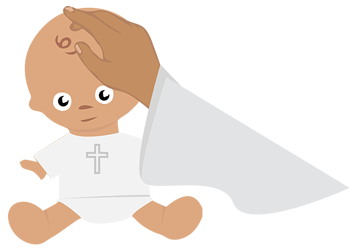
Sign of the Cross
The Sign of the Cross is the mark of Christians. Every time we make the Sign of the Cross, it is a reminder of the life, suffering, death and resurrection of Jesus Christ. It acknowledges the Trinity (God the Father, God the Son and God the Holy Spirit) and of our identity as Christians. Parents and godparents trace the cross on the child’s forehead as a sign they are claimed by the One who has created us all, and who came among us in Jesus, and who continues to journey with us in the Spirit, and who will welcome us home in the life to come.
What do I need to do if I want to have my child baptised?
If you’re considering Baptism for your child—what a wonderful step! To begin the process, simply reach out to your local parish. If you’re unsure who to contact, we have a helpful page to guide you in finding the parish nearest to you.
Most parishes ask parents to take part in a Baptism preparation program. This is a gentle and enriching way to grow in your understanding of Baptism, explore the celebration of the sacrament and reflect on the commitment you’re making: to nurture your child in faith and help them grow in the love of God.
How do I nurture my child's faith?
This is a great question!
The Church holds you, as parents, in very high esteem. Research tells us that parents are the most significant influence on the religious and spiritual lives of children. It’s the way you live and model faith in your conversations, practices and relationships that makes all the difference.
That doesn’t mean you have to be perfect – none of us are – but it does mean we’re invited to have real, authentic relationships with God that witness to our children that they can have a relationship with God that’s real too. That’s why the Church calls parents the ‘first educators’ or ‘first heralds’ of the faith – not because of what you know, but because of who you are as you authentically live out your faith in the messiness of day-to-day life.
Of course, you’re not alone in this! The promises made in the Rite of Baptism remind us that this celebration is not just a private ceremony between us and God. In Baptism we are initiated into a community of faith in a way that can never be undone.
With that in mind, here are some practical ideas for nurturing your child’s faith:
- Make prayer a part of your family life. This can start with something as simple as tracing the Sign of the Cross of your child’s forehead as you tuck them into bed. Perhaps you could give thanks in your own words before meals or use traditional prayers of the Church.
- Mark the anniversary of your child’s (or godchild’s) Baptism each year in some way – a small card or faith focused gift, a meal with godparents might be ways to celebrate?
- Display items in your home that remind the family about faith. Pictures, inspirational quotes and scripture verses, statues etc can create visual prompts that turn our hearts to God even in the messiest family moments!
- Add bible stories to your child’s collection of books and enjoy reading them together.
- Your child’s name is a special part of their baptism and a regular reminder that God knows them and calls them by name. In fact, Pope Francis said, “God allows parents to choose the name by which he himself will call their child for all eternity” (AL, 166). So, as they grow up, remember to tell your child what their name means and the story behind why you chose it for them.
- Get involved in your local parish community. Many parishes include activities for children such as Children’s Liturgy of the Word during Sunday mass or other events to welcome and include families. If regular mass attendance is not something you are accustomed to, perhaps begin by taking your child to mass during special celebrations throughout the year. You might also ask another family to attend with you to support one another and make it more fun!
- You can find lots of other resources and ideas on the Children and Families page on the Archdiocesan Ministries website. For resources and opportunities to nurture your own faith, check out all that the Adult Formation team has to offer also!
Frequently asked questions about Baptism
To follow up with these, or any other questions, contact your local parish. The parish office staff will put you in touch with either the parish priest or another suitable person who will assist you in the process of your child’s Baptism.
Where can I find out more about Baptism?
Here are just a few places you can read about Baptism in the bible:
- Baptism of Jesus – Matthew 3:13-17
- St Paul helps us to understand how through Baptism we follow Jesus – Romans 6:3-4, 6
- St Paul helps us to understand how Baptism makes us all one – Galatians 3:27-28
You can also read more in the Catechism of the Catholic Church in the section entitled ‘The Sacrament of Baptism’ paragraphs 1213-1284
What if I am not Catholic but my child’s father / mother is?
For pastoral reasons, it is preferred that at least one parent is a baptised Catholic and that the parents are happy to raise the child in the Catholic tradition.
Who can be baptised in the Catholic Church?
Any child with a parent who desires that their child be baptised in the Catholic Church and who is willing to raise their child in the Catholic tradition.
Can you be baptised more than once?
Baptism into the Christian faith occurs only once.
I am no longer in communication with my child’s mother / father – do I need to get their permission to have our child baptised?
You need to discuss your situation with your local parish.
What if I am not married – am I still able to get my child baptised?
Of course! Baptism is about the child, not the parent’s circumstances. The Church’s hope is that parents are presenting their child with a desire to share their faith in God and to connect with the Church community. The Church focuses on the child, as well as the responsibilities of those who have guardianship of the child.
When should I have my child baptised?
You can have your baby or child baptised at any age although the Sacramental Policy (Archdiocese of Brisbane) suggests that this occurs within the first 12 months.
My child is no longer a baby – can they still be baptised?
Baptism can occur at any age although preparation for this varies depending on your child’s age. Your parish will be able to assist you with this process
What does it mean to have your child ‘baptised’?
Having your child baptised means that they are incorporated into the Body of Christ and have begun the process of initiation into the Catholic Church which will be completed through the sacraments of Confirmation and First Communion. Within the Baptism ritual parents promise to support and nurture their child’s Christian life.
What is the difference between Christening and Baptism?
There is no difference between Baptism and Christening. The Catholic Church recognises the first sacrament of initiation to be Baptism, which comes from a Greek word used in Scripture meaning to ‘plunge’ or immerse. ‘Christening’ is derived from Middle English and means to make Christian and is also connected with the term “Christ” which means “anointed one”. Therefore, it is also connected to the “Chrismation” – or “anointing” – of the baptismal ceremony.
How do I choose a godparent and what do they do?
A godparent is to be 16 years or older and fully initiated into the Catholic Church, i.e. one who has been baptised and been Confirmed and celebrated First Communion. One godparent needs to be Catholic although practising individuals of other Christian traditions are welcome to be witnesses. Non-Christians are unable to be witnesses.
There is no legal obligation as a godparent. It is a ministry of love and a privilege to be invited. Godparents are chosen with the hope that they practise their faith regularly and will be a positive spiritual guide and good moral mentor for the baptised child.
Why might there be several families celebrating Baptism at the same time?
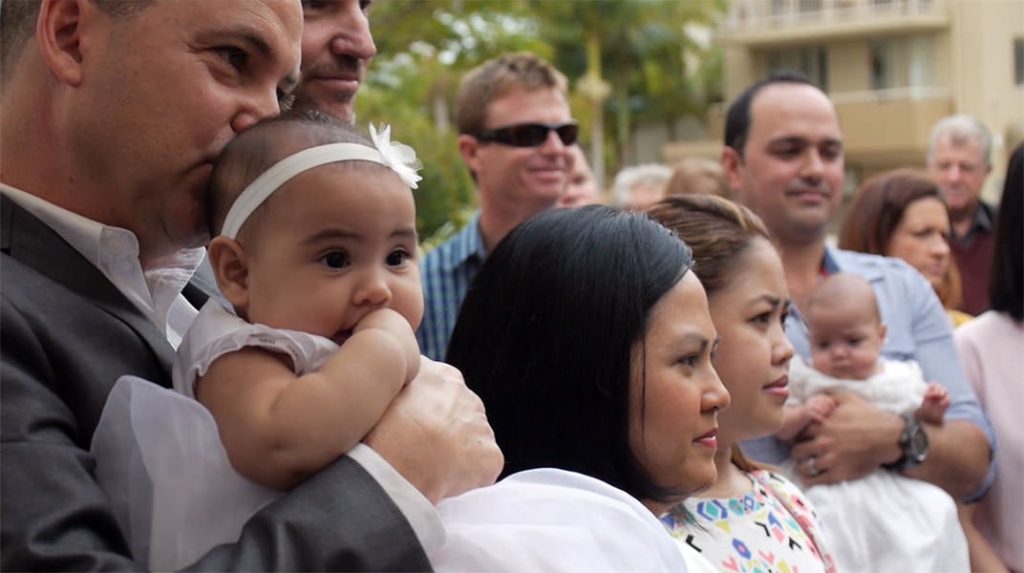
Baptism is a communal celebration. It is not a private family occasion. Therefore, Baptisms are normally conducted during Sunday Mass or might be celebrated with several other families at another time in the parish church.
Resources for Baptism
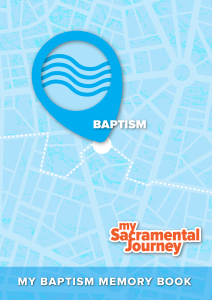
My Baptism Memory Book
‘My Baptism Memory Book’ is a 20 pages book for parents, grand-parents, godparents, parishioners, or friends of an infant to recall the day of Baptism and is intended to be completed post-Baptism. It makes an ideal keepsake for children. This could also be given to school aged children in addition to the; my sacramental journey: Baptism book. This resource is available for sale through the Archdiocesan Ministries online store.
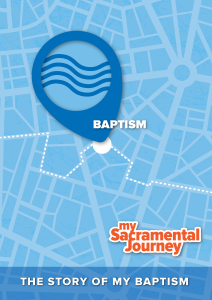
The Story of My Baptism
‘The Story of My Baptism’ is a 20 page book to be used with young children and their families as they prepare for the Sacrament of Baptism. This resource is available for sale through the Archdiocesan Ministries online store.
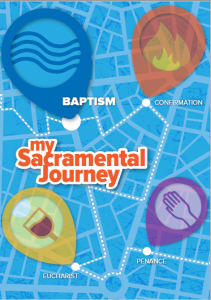
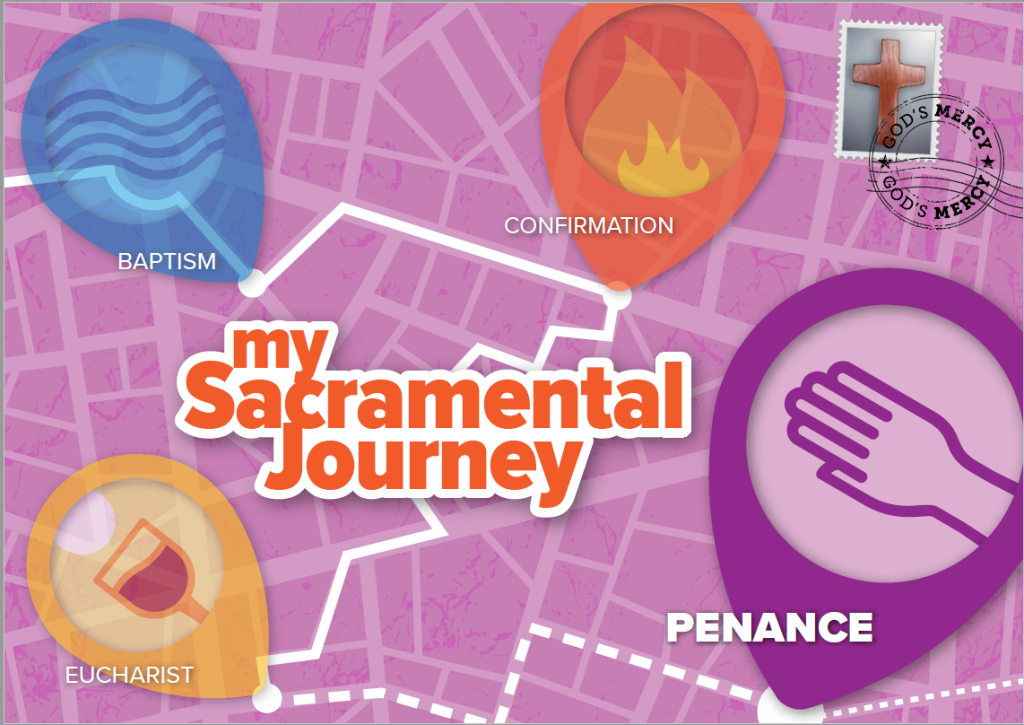
my Sacramental Journey: Baptism
‘my Sacramental Journey: Baptism’ is a 16 page activity book for school aged children who are preparing for Baptism and then will join in the parish sacramental processes for the preparation and celebration of Confirmation and Eucharist. The book uses scripture, prayer and family fun activities to explore Jesus, their church community, and their Baptism. This resource is available for sale through the Archdiocesan Ministries online store.
What is Confirmation?
Confirmation is one of the three Sacraments of Initiation in the Catholic Church.
In 1971, Pope Paul VI said that “Confirmation makes the grace of Pentecost perennial in the Church.” In other words, the grace poured out on the disciples at Pentecost continues to be given to the Church and its people through the Sacrament of Confirmation.
In the Old Testament, we read of prophets upon whom God’s Spirit rested for a particular mission in God’s unfolding story. It was the prophet Joel who foretold a time after Jesus’s death and resurrection when God would “pour out the Spirit on all people” (Joel 2:28). This was fulfilled in Acts 2, where we read about the coming of the Holy Spirit at Pentecost.
When the Holy Spirit came upon Mary and the disciples, they were profoundly transformed:
- They were more perfectly united with God and the Church.
- They were strengthened to be witnesses of Christ Jesus.
- They were empowered with gifts to share in Jesus’ mission and proclaim the Good News to all.
The same is true for us! Through the Sacrament of Confirmation:
- We are more deeply united with God and the Church.
- We are strengthened to be witnesses for Christ Jesus.
- We are empowered with gifts to share the Good News of Jesus with all.
As St Pope John Paul II said in 1998, “Confirmation makes us share fully in the outpouring of the Holy Spirit by the risen Lord.”
What happens during the Sacrament of Confirmation?
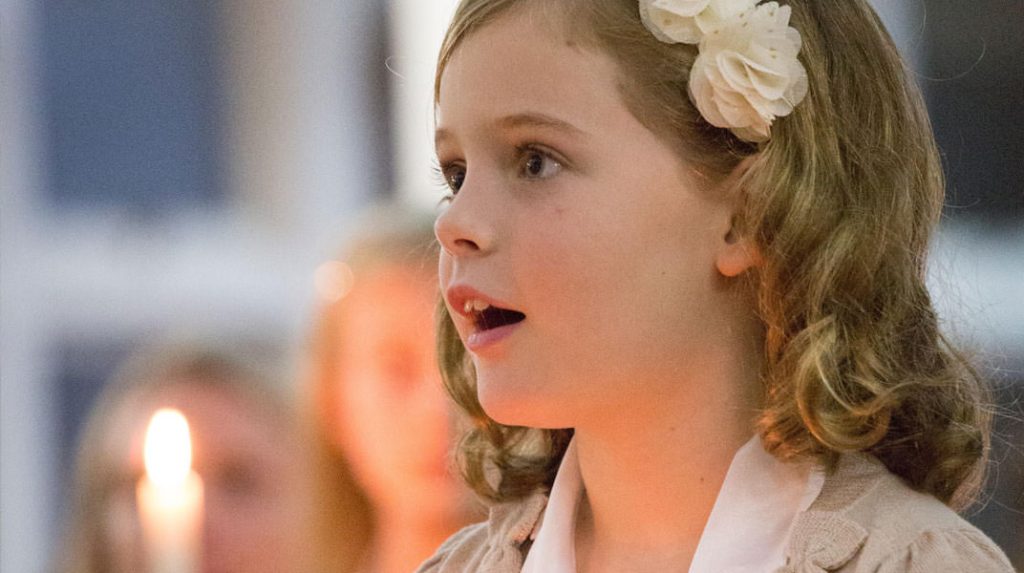
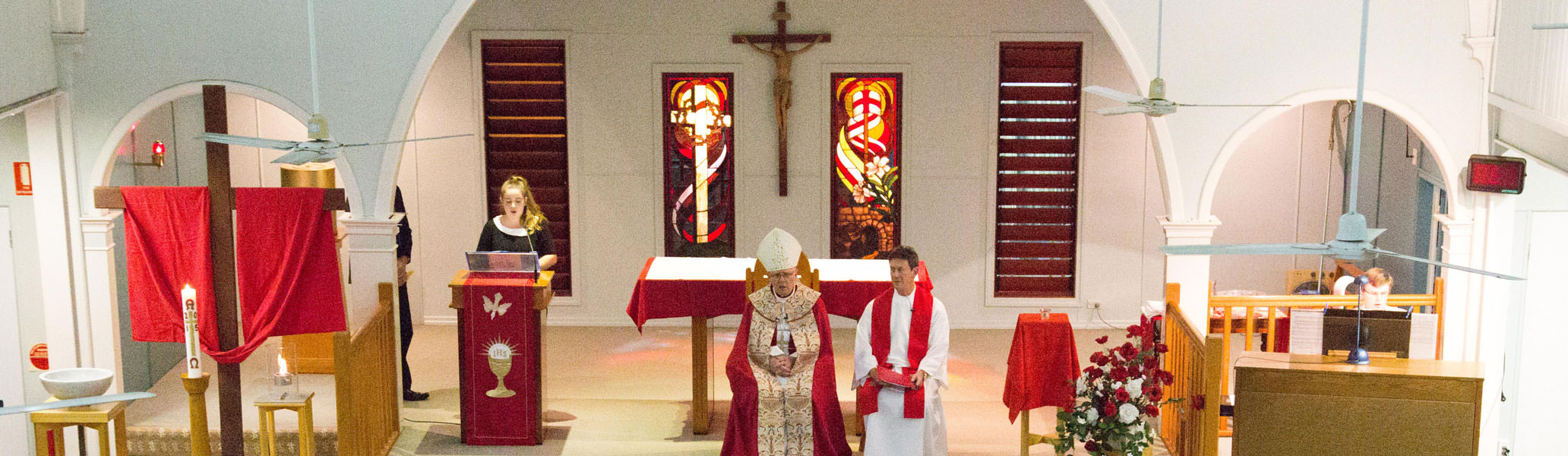
The Sacrament of Confirmation involves the renewal of baptismal promises, the laying on of hands and anointing with the oil of Chrism. The anointing of the candidate is a sign of confirming the gift of the Spirit and calling the candidates to use these gifts to become involved in the life and mission of the Church.
Usually, the bishop presides over this sacrament.
What are the important symbolic actions of Confirmation?
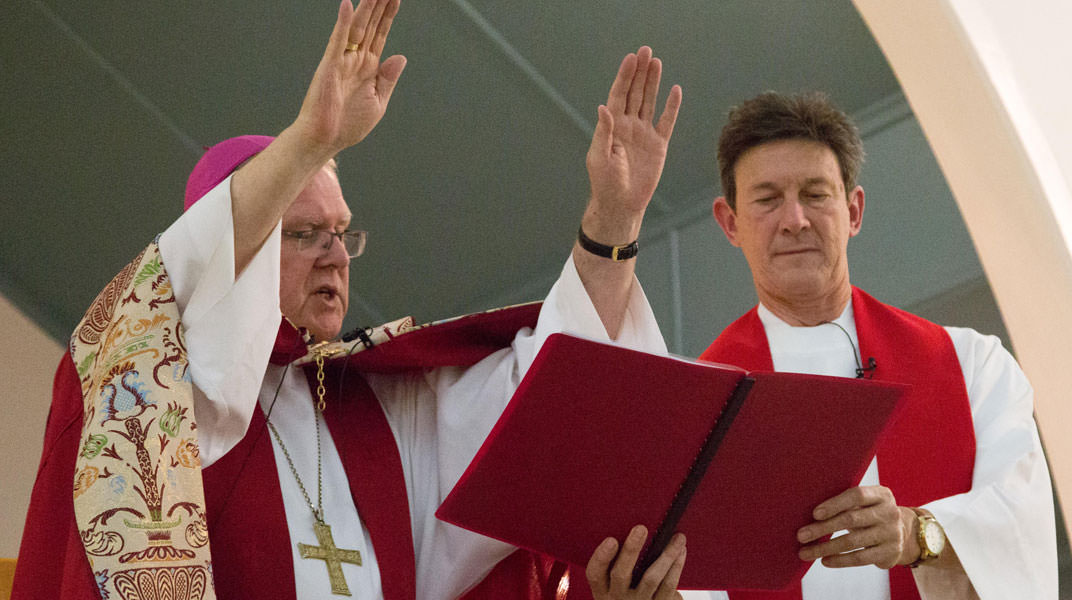
The Laying On of Hands
The bishop places his hands on the head of the candidates and prays for the gifts of the Holy Spirit. This is an ancient gesture that was practiced by the early Church.
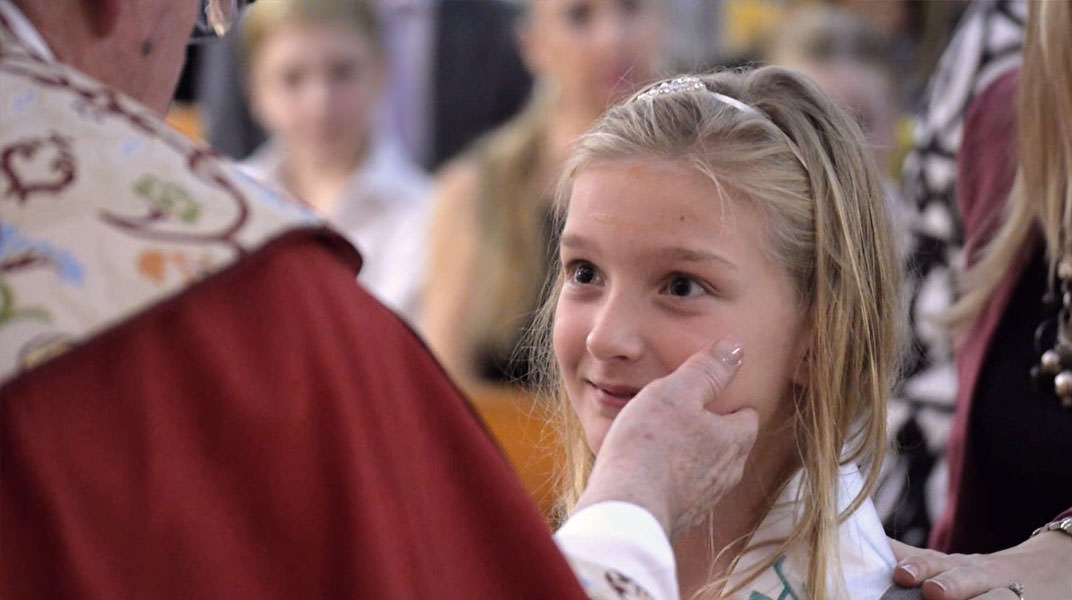
The Sign of Peace
At the end of the rite, the bishop puts his hand on the side of the candidate’s face and says ‘Peace be with you’ and the candidate replies with ‘And with your spirit’, symbolising the candidate’s place within the Church community.
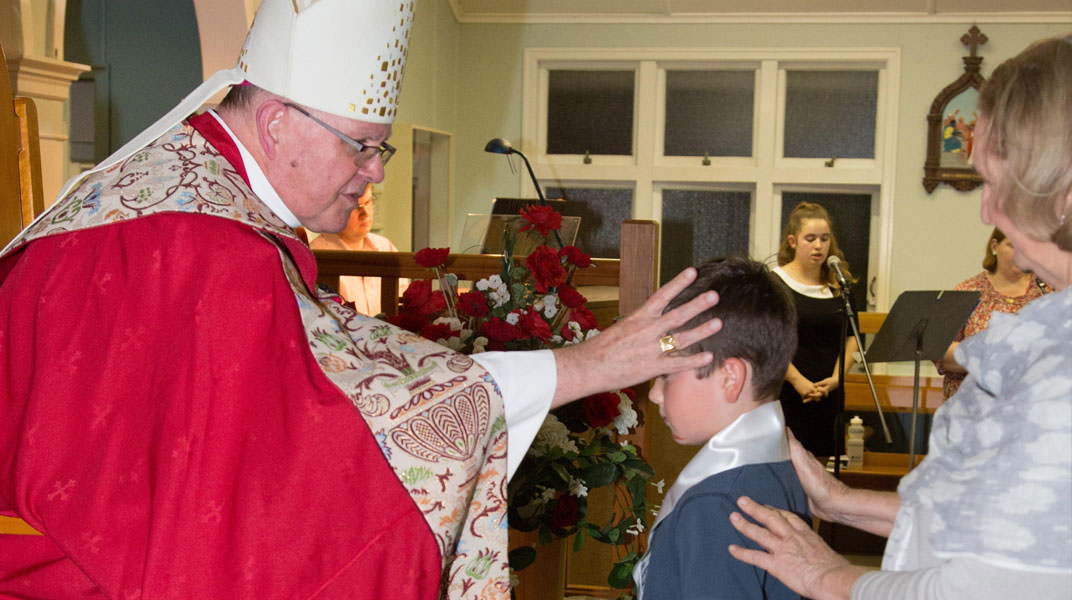
Anointing with Oil
The anointing of the candidate at Confirmation recognises that they are sealed with the Holy Spirit so that their lives may be filled with the ‘aroma of Christ’.
As the bishop anoints the candidate’s forehead with the Oil of Chrism, he says ‘Be sealed with the gift of the Holy Spirit’.
What do I need to do if I would like to have my child confirmed?
If you’re considering Confirmation for your child—what a wonderful step! To start the process to be confirmed you will need to contact your local parish. We have a page to help you contact your nearest parish if you are unsure of your parish contact details.
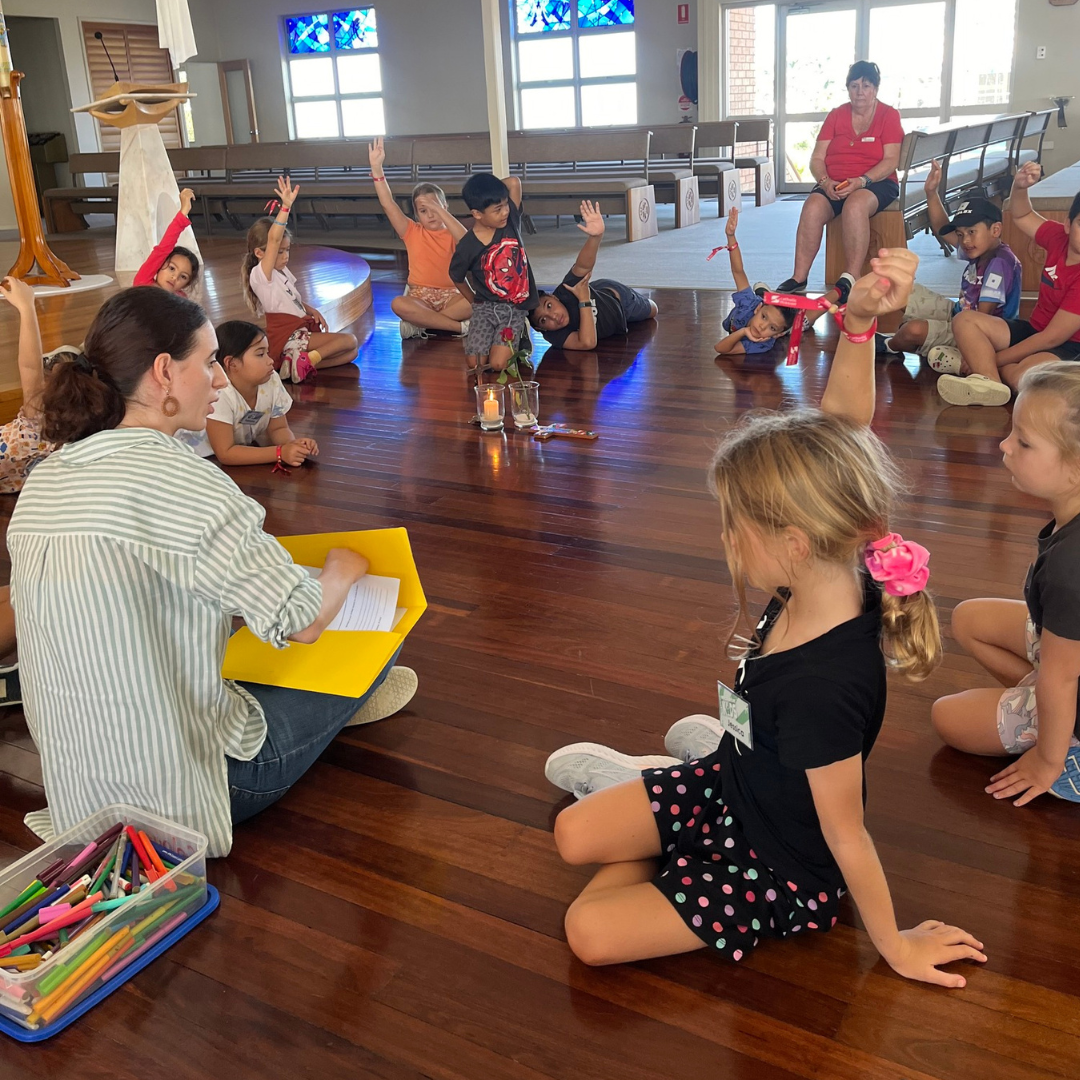
All parishes will engage parents and children in a time of preparation for the Sacrament of Confirmation. This will likely involve sessions for parents, workshops for parents and children together and things for your to do together at home. As a Sacrament of Initiation, you can also expect moments throughout the preparation that involve the faith community such as Sunday mass.
Your parish will give you more information.
How can I nurture my child's faith?
This is a great question!
The Church holds you, as parents, in very high esteem. Research tells us that the most significant influence that shapes the religious and spiritual lives of children is their parents. It’s the way you live and model faith in your conversations, practices and relationships that makes all the difference.
That doesn’t mean you have to be perfect – none of us are – but it does mean we’re invited to have real, authentic relationships with God that witness to our children that they can have a relationship with God that’s real too. That’s why the Church calls parents the ‘first educators’ or ‘first heralds’ of the faith – not because of what you know, but because of who you are as you authentically live out your faith in the messiness of day-to-day life.
Of course, you’re not alone in this! The promises made on the day of your child’s Baptism remind us that the Sacraments of Initiation are not just private ceremonies between us and God. Through these sacraments, we are initiated into a community of faith in a way that can never be undone.
With that in mind, here are some practical ideas for nurturing your child’s faith:
- Make prayer a part of your family life. This can start with something as simple as tracing the Sign of the Cross of your child’s forehead as you tuck them into bed. Perhaps you could give thanks in your own words before meals or use traditional prayers of the Church.
- Mark the anniversary of your child’s (or godchild’s) Baptism each year in some way – a small card or faith focused gift, a meal with godparents might be ways to celebrate?
- Display items in your home that remind the family about faith. Pictures, inspirational quotes and scripture verses, statues etc can create visual prompts that turn our hearts to God even in the messiest family moments!
- Add bible stories to your child’s collection of books and enjoy reading them together.
- Your child’s name is a special part of their baptism and a regular reminder that God knows them and calls them by name. In fact, Pope Francis said, “God allows parents to choose the name by which he himself will call their child for all eternity” (AL, 166). So, as they grow up, remember to tell your child what their name means and the story behind why you chose it for them.
- Some parishes, and certainly in some families, there is a tradition of taking a saint’s name as your Confirmation name. If that is the case for your child, take the opportunity to read up on some saints your child might be interested in. A good place to start is to do an internet search for saints who are patrons of things your child is interested in.
- Get involved in your local parish community. Many parishes include activities for children such as Children’s Liturgy of the Word during Sunday mass or other events to welcome and include families. If regular mass attendance is not something you are accustomed to, perhaps begin by taking your child to mass during special celebrations throughout the year. You might also ask another family to attend with you to support one another and make it more fun!
- You can find lots of other resources and ideas on the Children and Families page on the Archdiocesan Ministries website. For resources and opportunities to nurture your own faith, check out all that the Adult Formation team has to offer also!
Frequently asked Questions about Confirmation
Where can I find out more about Confirmation?
You can read about Coming of the Holy Spirit at Pentecost in the bible:
Jesus promises the Holy Spirit – John 14:15-17
Pentecost – Acts 2:1-47
You can also read more in the Catechism of the Catholic Church in the section entitled ‘The Sacrament of Confirmation’ paragraphs 1285-1321
Who can be confirmed?
Any baptised person can be admitted for Confirmation preparation.
Confirmation Name
While choosing a Confirmation name has never been an official part of the sacrament, it has been a popular custom in many places.
It is also appropriate for a candidate to be confirmed using their given name from baptism. This practice affirms the deep connection between Baptism and Confirmation.
If a saint’s name is chosen, choose the name of a saint who inspires the child. This practice affirms our connection with the great Christian story.
Who should I choose as a sponsor?
Confirmation is a reaffirmation of the promises made at Baptism, so it is fitting for a child’s godparent take on the role of sponsor for Confirmation. Otherwise, sponsors should be at least 16 years old, not the child’s parent, a Catholic who has been confirmed, receives Communion and who lives a life of faith.
What is the responsibility of the sponsor?
Since a sponsor has such a significant role to play in the development of the candidate for Confirmation, it is important that this person be one who is a living example of faith, one whose actions reflect the actions of Jesus. A Confirmation sponsor offers support and encouragement during the Confirmation preparation process.
During the Confirmation ceremony sponsors bring the candidates forward and present them to the bishop.
Resources for Confirmation
Archdiocesan Ministries has developed the following resources to assist with preparation for Confirmation in the Archdiocese of Brisbane.
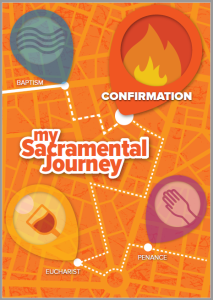
My Sacramental Journey: Confirmation
‘my Sacramental Journey: Confirmation’ is a 16 page activity book designed for children preparing for the Sacrament of Confirmation. This resource is available for sale through the Archdiocesan Ministries online store. Also, be sure to download a free copy of the accompanying Parent Guide.
What is Eucharist?
Eucharist is one of the three Sacraments of Initiation in the Catholic Church.
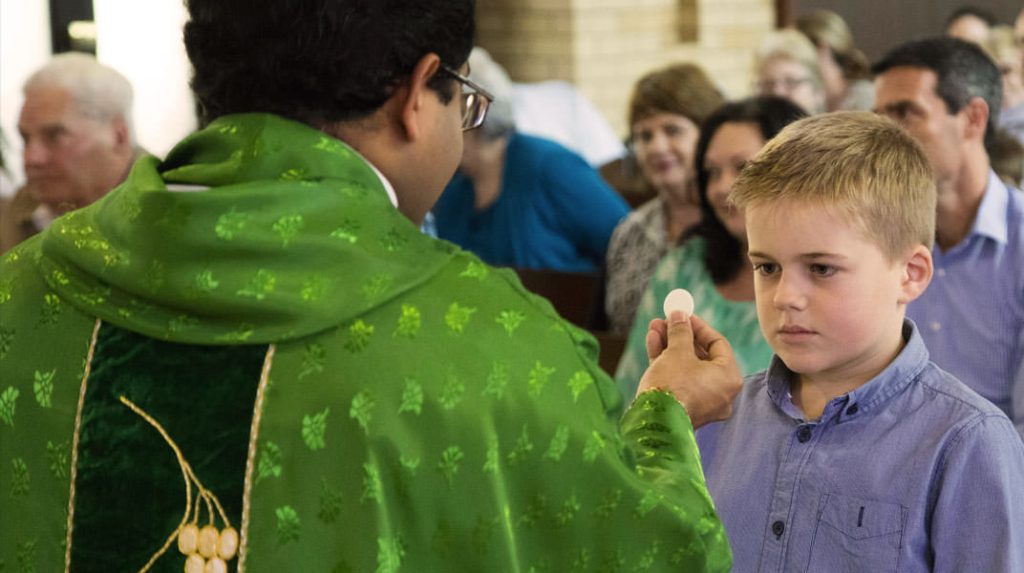
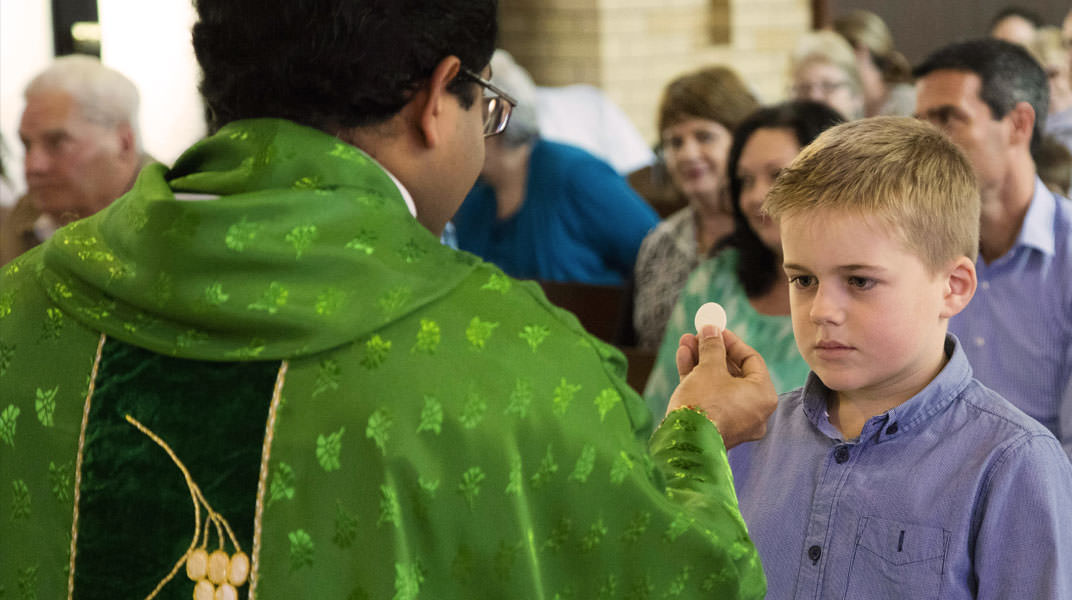
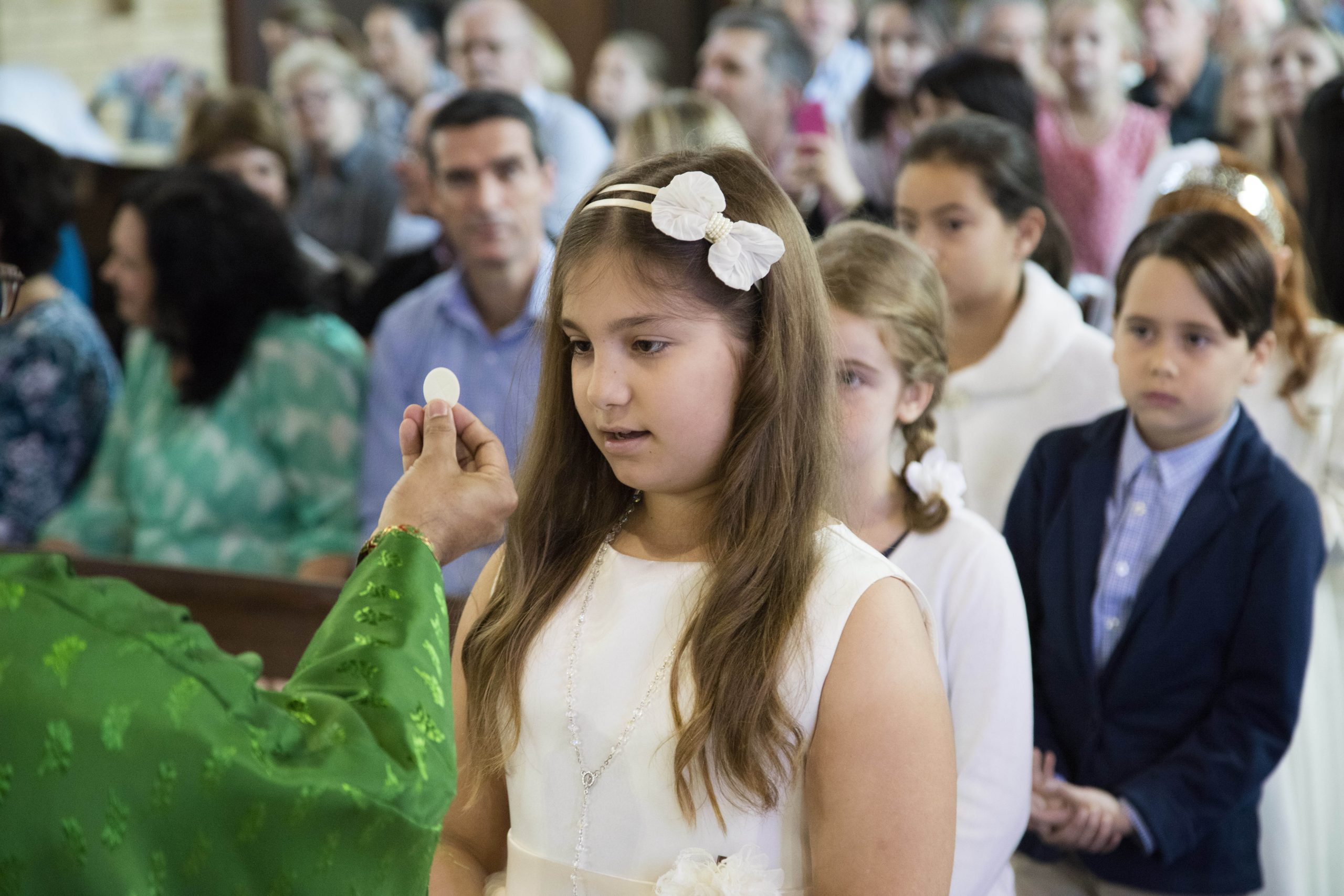
Eucharist is unique among the sacraments, and for Catholics, it is the most powerful way we encounter the real presence of Jesus Christ. That’s why, Sunday after Sunday, Catholics gather to celebrate Mass in which, by the power of the Holy Spirit, bread and wine are transformed into the Body and Blood of Christ.
But the transformation doesn’t stop there! We are transformed too!
When we receive the Body and Blood of Christ in the Eucharist we are united with Christ Jesus and the whole Church, we are strengthened and sustained to live the Christian life, and we are sent out to share his love and message with everyone!
In the Catechism of the Catholic Church it says, “The inexhaustible richness of The Eucharist is expressed in the different names we give it. Each name evokes certain aspects of it” (CCC 1328).
Here are some of those names:
- EUCHARIST – this name comes from the Greek words ‘eucharistein’ and ‘eulogein’ meaning to proclaim God’s amazing works, especially during a meal!
- THE LORD’S SUPPER – because of its connection to the Last Supper Jesus celebrated with his disciples and because it gives us a glimpse of the heavenly feast to come when Christ Jesus and his Church will be fully united.
- THE BREAKING OF BREAD – because that’s what Jesus did during the Last Supper. It’s also how the disciples recognised him after his resurrection on the road to Emmaus in Luke 24:13-35 and it’s what the early Christians did when they came together in communion with Christ Jesus and with each other.
- THE EUCHARISTIC ASSEMBLY – because Eucharist is celebrated when we all come together! Together, we are the visible expression of the Church today!
- THE MEMORIAL OF THE LORD’S PASSION AND RESURRECTION – because it makes present all that Jesus accomplished through his passion, death on the cross and resurrection to new life!
- HOLY COMMUNION – because as we share in the Body and Blood of Christ Jesus, we are united with Him to make one body together.
- HOLY MASS – this comes from the Latin word ‘missa’ meaning ‘dismissal’ and is the root of the English word ‘mission’. It reminds us that the Eucharist fuels us to be missionary disciples in our world each day!
What happens during Eucharist?
The Eucharist is the whole ritual that has come to be known as the Mass. This liturgy follows the same fundamental structure which has come down to us from the time of the apostles.
The celebration of The Mass includes:
- the sharing of the Word from scripture
- offering of prayers
- doing what Jesus did at the Last supper taking, blessing, breaking and sharing his body and blood
- being sent forth to live and proclaim the Good News
What are symbols and important moments in the celebration of Eucharist?
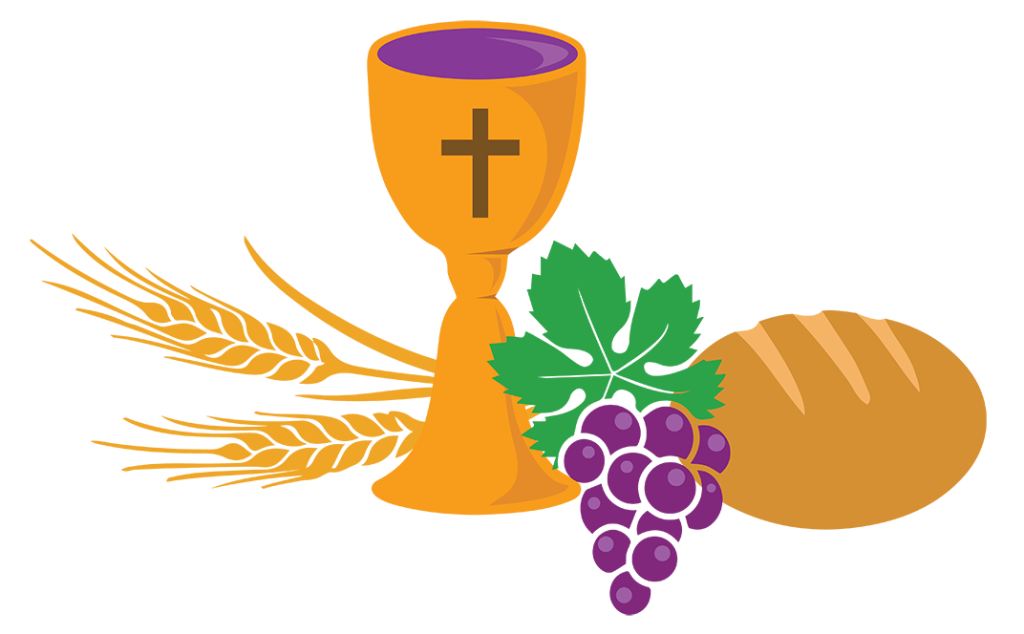
- Bread – Wheat is grown and ground, transformed by human work to make bread. Bread is a staple food of life.
- Wine – Grapes are grown and crushed, transformed by human work to make wine. Wine symbolises joy and celebration.
- At the Last Supper Jesus gave himself in the form of bread and wine. During the Mass, the priest does what Jesus did in the scripture when it says, “During the meal Jesus took some bread in his hands. He blessed the bread and broke it. Then he gave it to his disciples and said, ‘Take this and eat it. This is my body.’ Jesus picked up a cup of wine and gave thanks to God. He then gave it to his disciples and said, “Take this and drink it. This is my blood, and with it God makes his agreement with you. It will be poured out, so that many people will have their sins forgiven.” (Matthew 26:26-28)
What do I need to do if I would like to have my child receive their First Holy Communion?
If you’re considering First Communion for your child—what a wonderful step! To start the process you will need to contact your local parish. We have a page to help you contact your nearest parish if you are unsure of your parish contact details.
All parishes will engage parents and children in a time of preparation for the Sacrament of Eucharist. This will likely involve sessions for parents, workshops for parents and children together and things for your to do together at home. As a Sacrament of Initiation, you can also expect moments throughout the preparation that involve the faith community such as Sunday mass.
Your parish will give you more information.
How can I nurture my child's faith?
This is a great question!
The Church holds you, as parents, in very high esteem. Research tells us that parents are the most significant influence on the religious and spiritual lives of children. It’s the way you live and model faith in your conversations, practices and relationships that makes all the difference.
That doesn’t mean you have to be perfect – none of us are – but it does mean we’re invited to have real, authentic relationships with God that witness to our children that they can have a relationship with God that’s real too. That’s why the Church calls parents the ‘first educators’ or ‘first heralds’ of the faith – not because of what you know, but because of who you are as you authentically live out your faith in the messiness of day-to-day life.
Of course, you’re not alone in this! The promises made on the day of your child’s Baptism remind us that the Sacraments of Initiation are not just private ceremonies between us and God. Through these sacraments, we are initiated into a community of faith in a way that can never be undone.
With that in mind, here are some practical ideas for nurturing your child’s faith:
- Make prayer and thanksgiving a part of your family life. Perhaps you could give thanks in your own words before meals or use traditional prayers of the Church.
- Display items in your home that remind the family about faith. Pictures, inspirational quotes and scripture verses, statues etc can create visual prompts that turn our hearts to God even in the messiest family moments!
- Add bible stories to your child’s collection of books and enjoy reading them together.
- The Sacrament of Eucharist is one that can be received many times throughout the life of a Catholic so make time for your child to partake as often as you are able.
- ‘Living’ the Eucharist means sharing the love and presence of Jesus with those around us. A great way to help our children experience this is to engage in works of social justice and charity. There are many Catholic organisations close to home and abroad to contribute to such as: The Romero Centre, Catholic Earthcare, Project Compassion, Emmanuel City Mission, Catholic Mission’s Socktober, St Vincent de Paul Society, and Rosies.
- Get involved in your local parish community. Many parishes include activities for children such as Children’s Liturgy of the Word during Sunday mass or other events to welcome and include families. If regular mass attendance is not something you are accustomed to, perhaps begin by taking your child to mass during special celebrations throughout the year. You might also ask another family to attend with you to support one another and make it more fun!
- You can find lots of other resources and ideas on the Children and Families page on the Archdiocesan Ministries website. For resources and opportunities to nurture your own faith, check out all that the Adult Formation team has to offer also!
Frequently asked Questions about Eucharist
Where can I find out more about Eucharist?
You can read about the Sacrament of Eucharist in the bible:
- Jesus says that he is the ‘Bread of Life’ – John 6:22-59
- The accounts of the Last Supper can be found in these Gospels – Matthew 26:26-29, Mark 14:22-25, Luke 22:17-20
- Eucharist in the early Church – Acts 2:42, 1 Corinthians 11:23-26
You can also read more in the Catechism of the Catholic Church in the section entitled ‘The Sacrament of Eucharist’ paragraphs 1322-1419
Who prepares the children for Eucharist?
Preparation for Eucharist is done by parents and the parish, and offers children a variety of activities, prayer and practical help to form their understanding and participate in the celebration of the sacrament. Parishes work with families to help parents prepare their children to grow in their friendship with Jesus and their connection to the Church community.
What happens if my child is coeliac?
If your child suffers from allergies speak to the priest or sacramental coordinator. Low gluten hosts are available.
What does my child need to wear?
This will depend on a variety of situations, traditions and wishes of the families involved and guided by parish practice. Candidates are encouraged to wear what is age appropriate and culturally appropriate for their family.
Resources for Eucharist
Archdiocesan Ministries has developed the following resources to assist with preparation for Eucharist in the Archdiocese of Brisbane.
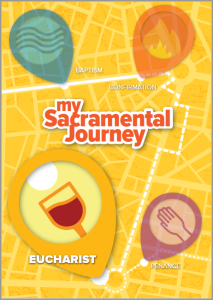
my Sacramental Journey: Eucharist
‘my Sacramental Journey: Eucharist’ is a 20 page activity book designed for children and their families as they prepare for the Sacrament of Eucharist. The book takes the children on the final part of their journey to full initiation in the Catholic Church exploring scripture, prayer, the Mass, and family fun activities. Purchase through the Archdiocesan Ministries online store. Also, be sure to download a free copy of the accompanying Parent Guide.
What is Penance?
The Sacrament of Penance is one of two sacraments of healing (the other being the Anointing of the Sick).
Penance is a sacrament of forgiveness and celebrates God’s love and mercy towards us. It is about acknowledging and naming those times when we know we have done wrong, and then making peace and restoring the relationships with those who have been affected by our poor choices.
The Sacrament of Penance is celebrated through the Rites of Reconciliation.
What happens during Penance?
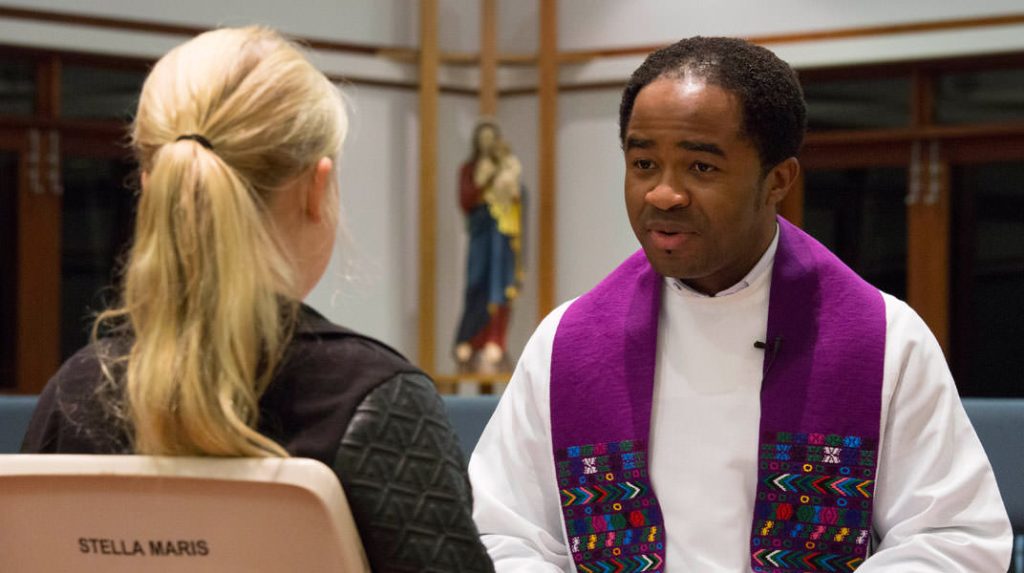
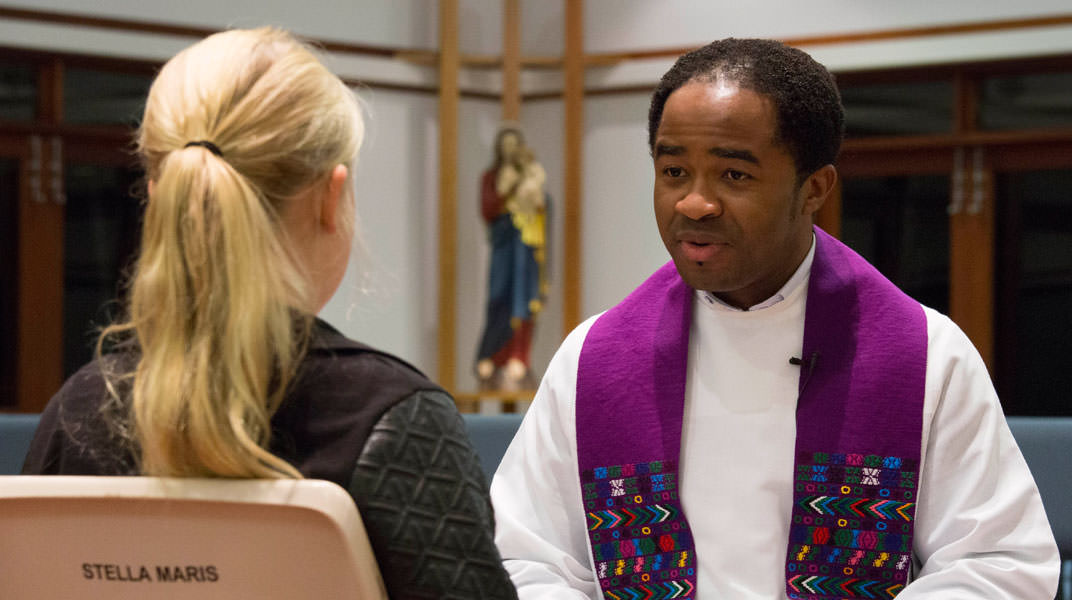
Penance involves the individual acknowledging their sins and receiving the forgiveness of God through the ministry of the priest.
Through this process, a person is reconciled with the Church, renews his or her Baptism, and continues to live as a disciple of Jesus.
Frequently Asked Questions about Penance
To follow up with these, or any other questions, contact your local parish. The parish office staff will put you in touch with either the parish priest or another suitable person who will assist you in the process of your child’s Reconciliation.
Why so many different names for the same sacrament?
The names emphasise different aspects of the sacrament.
Penance refers to our remorse, sorrow and resolution to amend our life with God’s help. Confession refers to the act by which we tell our sins to the priest.
Reconciliation refers to the goal of the celebration which is that sinners are reconciled to God and the Church. The ritual is called the Sacrament of Penance, but is appropriate to refer to it with any of these titles.
What are the different ways that Reconciliation can occur?
There are three different forms that the Sacrament of Penance can take.
- First form or Rite of Reconciliation is when we individually confess our sins to the priest.
- Second form or Rite of Reconciliation is a celebration that occurs within the Church with the whole community and involves individual confession and absolution.
- Third form or Rite of Reconciliation is also centred on the gathering of the community but is rarely celebrated as it is designed for situations where there is a grave necessity.
When will my child be prepared for the Sacrament of Penance?
In the Archdiocese of Brisbane children will celebrate a simple Second Rite of Reconciliation as part of their preparation for First Holy Communion. They will be formally prepared for the Sacrament when they are a little older and have a greater understanding, at about ten years old.
Can a priest tell someone else about what they have heard in Confession?
When a person confesses their sins to a priest in the Sacrament of Penance, a very sacred trust is formed. The priest must maintain absolute secrecy about anything that a person confesses. This secrecy is called “the seal of confession”. Under no circumstances is the priest allowed to break this sacred seal.
What do I need to do if I would like to have my child receive the Sacrament of Penance?
n the Archdiocese of Brisbane children will celebrate a simple Second Rite of Reconciliation as part of their preparation for First Holy Communion. If your child is a little bit older – about ten years old – it is felt that they may have a greater understanding and may be formally prepared to receive the Sacrament of Penance in the First form or Rite of Reconciliation.
If you’re considering this for your child—what a wonderful step! As a Sacrament of Healing, you are giving your child the extraordinary gift of knowing and experiencing God’s unconditional love, not just once, but every time they choose to receive the Sacrament of Penance throughout their life as a Christian.
To start the process to be you will need to contact your local parish. We have a page to help you contact your nearest parish if you are unsure of your parish contact details.
All parishes will engage parents and children in a time of preparation for the Sacrament of Penance. This will likely involve sessions for parents, workshops for parents and children together and things for your to do together at home.
Your parish will give you more information.
How can I nurture my child's faith?
This is a great question!
The Church holds you, as parents, in very high esteem. Research tells us that the most significant influence that shapes the religious and spiritual lives of children is their parents. It’s the way you live and model faith in your conversations, practices and relationships that makes all the difference.
That doesn’t mean you have to be perfect – none of us are – but it does mean we’re invited to have real, authentic relationships with God that witness to our children that they can have a relationship with God that’s real too. That’s why the Church calls parents the ‘first educators’ or ‘first heralds’ of the faith – not because of what you know, but because of who you are as you authentically live out your faith in the messiness of day-to-day life.
Of course, you’re not alone in this! The promises made on the day of your child’s Baptism remind us that the Sacraments of Initiation are not just private ceremonies between us and God. Through these sacraments, we are initiated into a community of faith in a way that can never be undone. Through all the sacraments, God gives us the grace to live the life of faith.
With that in mind, here are some practical ideas to continue nurturing your child’s faith:
- Make prayer and thanksgiving a part of your family life. Perhaps you could give thanks in your own words before meals or use traditional prayers of the Church.
- Display items in your home that remind the family about faith. Pictures, inspirational quotes and scripture verses, statues etc can create visual prompts that turn our hearts to God even in the messiest family moments!
- As your child grows older, particularly in their teen years, keep adding to their collection of books, music and other resources that nurture their faith.
- As your child grows older, particularly in their teen years, continue to talk about situations in their lives, and in the wider world. Encourage them to pray a quiet ‘Come Holy Spirit’ when they need guidance in difficult situations. These moments provide opportunities for your child’s conscience to be formed and helps them to navigate life when hard times come.
- The Sacrament of Penance is one that can be received many times throughout the life of a Catholic so make time for your child to partake as often as you are able.
- ‘Living’ and growing as a disciple means sharing the love and presence of Jesus with those around us. A great way to help our children experience this is to engage in works of social justice and charity. There are many Catholic organisations close to home and abroad to contribute to such as: The Romero Centre, Catholic Earthcare, Project Compassion, Emmanuel City Mission, Catholic Mission’s Socktober, St Vincent de Paul Society, and Rosies. These experiences also teach young people about being channels of God’s love and mercy to others.
- Get involved in your local parish community. Many parishes include activities for children and young people such as Children’s Liturgy of the Word during Sunday mass or other events to welcome and include families. If regular mass attendance is not something you are accustomed to, perhaps begin by taking your child to mass during special celebrations throughout the year. You might also ask another family to attend with you to support one another and make it more fun!
- You can find lots of other resources and ideas on the Children and Families page on the Archdiocesan Ministries website. For resources and opportunities to nurture your own faith, check out all that the Adult Formation team has to offer also! When your child is ready, reach out to the Youth and Young Adults team for information about events and youth groups to connect in with.
Resources for Penance
Archdiocesan Ministries have developed the following resources to assist with preparation for Penance in the Archdiocese of Brisbane.
my Sacramental Journey: Penance
‘my Sacramental Journey: Penance’ is a 16 page passport designed for children as they prepare for the Sacrament of Penance – First Rite for Reconciliation. The passport guides children using scripture, prayer, and journaling, and offers a call to action as they develop their understanding of forgiveness. Available to purchase through the Archdiocesan Ministries online store.
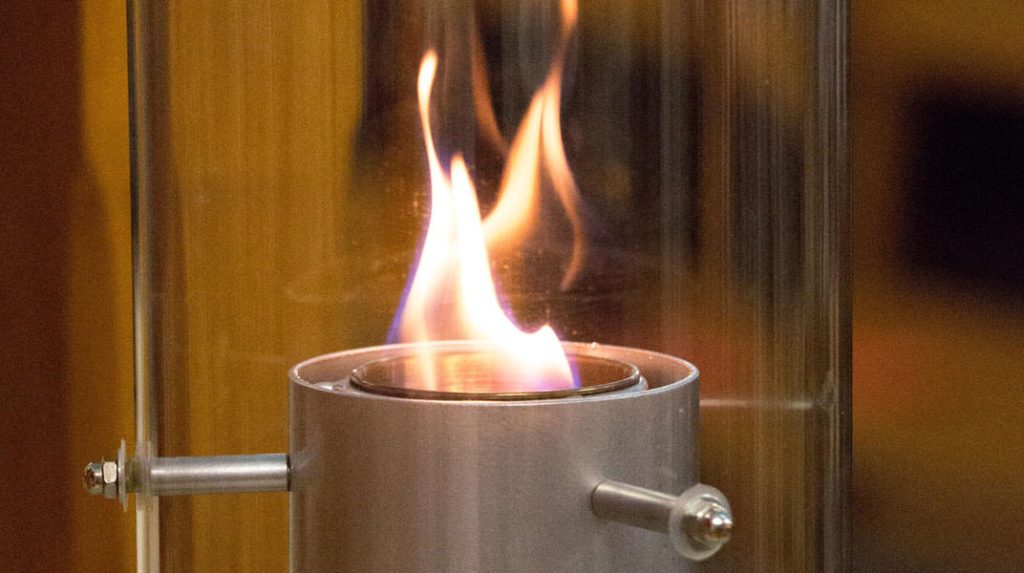
This light is entrusted to you to be kept burning brightly.
These children of yours have been enlightened by Christ.
They are to walk always as children of the light.
May they keep the flame of faith alive in the their hearts.Rite of Baptism for Children
CONTACT THE TEAM
We’d love to talk to you more about how to engage children and families through ministry in your local context.

Chantale Wilson
Director

Charlotte Pitot
Project Officer

Carrie McCormack
Project Officer

Sam Sachse
Project Officer
childrenandfamilies@bne.catholic.net.au
Phone
07 3324 3440